How to Choose pH Neutral Detergent for Delicate Optics?

Time:2026-10-19 Author:Sienna
0%

Delicate optics can lose performance from a single careless cleaning step. Fingerprints, dust, and oily residues may seem minor, yet they can scatter light or create permanent surface marks. Choosing the right detergent requires more than reading “mild” on a label. The formula should suit the coating, substrate, and cleaning method recommended by the optics manufacturer.

Why is pH neutral detergent safer for delicate optics? A balanced pH reduces the risk of chemical attack on sensitive coatings, glass surfaces, and bonding materials. Strongly acidic or alkaline cleaners may dull coatings, weaken cemented joints, or leave reactive residues. Still, pH neutrality does not guarantee complete safety. Surfactants, solvents, fragrances, dyes, and preservatives also matter. Read the technical data sheet carefully.

Small details matter.

Experienced optical technicians usually check compatibility information before cleaning an expensive lens or prism. They test a diluted solution on a hidden edge, use lint-free wipes, and avoid soaking assemblies with internal gaps. Clean water quality also deserves attention. Hard water can leave visible mineral spots after drying. A detergent that works well on laboratory glass may perform poorly on coated optics.

There is no universal “safe” cleaner. That assumption needs questioning. Follow the manufacturer’s instructions, prepare the correct dilution, and inspect the surface under angled light. Stop immediately if streaks, haze, color changes, or unusual resistance appear. A cautious selection process protects optical clarity and helps prevent damage that routine wiping cannot repair.
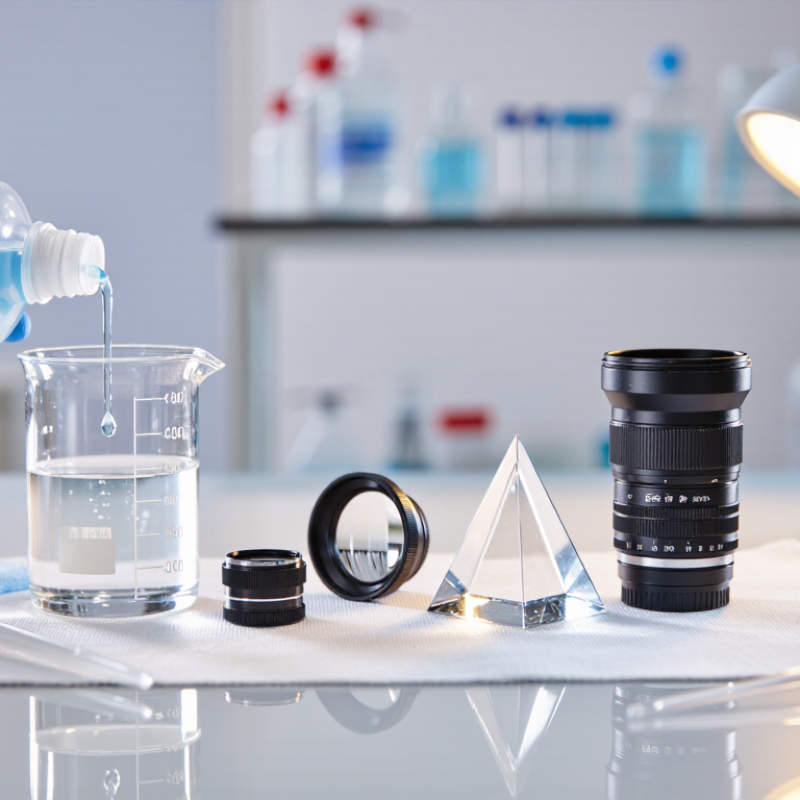
How to Choose pH Neutral Detergent for Delicate Optics?

Define “pH-Neutral” as the 6–8 Range for Optical Cleaning

For delicate optics, define pH-neutral as 6–8, not only as pH 7. The pH scale is logarithmic. A one-unit change means a tenfold change in hydrogen-ion activity, according to IUPAC guidance. That difference matters on coated lenses, mirrors, and fiber-optic faces. A solution at pH 10 may look harmless, yet it can accelerate coating stress or leave alkaline residue. ASTM E70 and ISO 4316 both support measuring pH in the prepared aqueous solution, not guessing from the concentrate label.

Choose a detergent that remains within pH 6–8 after dilution with controlled-purity water. Check the technical data sheet for surfactants, solvents, chelating agents, and residue information. pH alone does not prove optical safety. I once treated pH 7 as automatically safe; that assumption was too simple. A neutral cleaner can still damage a soft coating through abrasion, evaporation marks, or excessive contact time. Use a clean, low-lint swab and light, single-direction strokes. Never scrub a visible particle across the surface.

Tips: Measure the working solution at room temperature with a calibrated meter. Test it on a sacrificial coated sample first. Record dilution, pH, drying time, and inspection results. If the reading shifts outside 6–8, stop and investigate the water quality or mixing process.

How to Choose pH-Neutral Detergent for Delicate Optics

For optical cleaning, “pH-neutral” is defined here as the pH 6–8 range.

Choose a detergent whose working solution remains between pH 6 and 8. This range is close to neutral and is generally a safer starting point for delicate optical surfaces than strongly acidic or alkaline cleaners. Always follow the optic manufacturer’s cleaning instructions and rinse away residues.

Match Detergent Chemistry to Glass, Coatings, and 18.2 MΩ·cm DI Water

Choosing a pH-neutral detergent for delicate optics requires more than checking the number on the bottle. Glass, optical coatings, adhesives, and seals can react differently to the same formulation. A detergent marked “neutral” may still contain aggressive surfactants, chelating agents, or residues that affect transmission.

The coating matters most.

For bare glass, a low-residue nonionic surfactant is often suitable. Coated lenses need greater caution, especially when porous or multilayer films are present. Check the coating manufacturer’s chemical compatibility data before routine cleaning. Avoid formulas with strong builders, fragrances, dyes, or abrasive particles. I used to treat pH as the main safety indicator. That assumption was incomplete.

Rinsing quality is equally important.

Use freshly produced 18.2 MΩ·cm DI water when the optic and process allow it. This water contains very few dissolved ions, reducing mineral spots and ionic residue. However, DI water does not remove every organic film. The detergent must lift oil and fingerprints, while the rinse must carry loosened material away. Use clean, low-lint wipes and gentle, single-direction strokes. Never scrub a dried particle across a coating.

Test first.

Apply the detergent to a hidden edge or sacrificial optic. Inspect under angled light after drying. Look for haze, streaks, rainbow patches, or changes in contact behavior. Record dilution, water quality, temperature, and drying time. Small process details matter. A neutral detergent can still fail when overdosed or poorly rinsed.

Check Low-Residue Performance Through Ionic and Particle-Control Data

How to Choose pH Neutral Detergent for Delicate Optics?

Check Low-Residue Performance Through Ionic and Particle-Control Data

A pH-neutral label does not prove optical safety. A detergent may measure near pH 7 yet leave ionic films after drying. I evaluate the rinse water, not only the concentrate. Conductivity testing can reveal dissolved residues from salts, builders, or surfactant carryover. Ion chromatography may identify chloride, sulfate, sodium, and other specific contaminants. These details matter near coatings, adhesives, and fine apertures.

Particle data adds another layer. Ask for particle counts before and after cleaning, using a defined liquid volume and filter method. A useful comparison records particles above several size thresholds, such as 0.5, 1, and 5 micrometers. The test should include a detergent blank, rinse-water blank, and a soiled optic. Otherwise, the result can look cleaner than reality. It happens.

In practice, I prefer low-foaming formulas that rinse quickly with controlled-flow water. Foam can hide poor drainage around mounts and edges. I also inspect dried witness coupons under angled light, then verify them with microscopy or haze measurements. One limitation remains: a single laboratory test cannot represent every lens material or coating. Repeat testing with actual substrates, warm cycles, and realistic drying conditions. If ionic residue rises after repeated rinsing, the process needs adjustment, even when the surface appears visually clear. Delicate optics often fail quietly.

Verify Material Compatibility with Coating, Rubber, and Adhesive Tests

How to Choose pH Neutral Detergent for Delicate Optics?

A pH-neutral detergent usually measures between pH 6 and 8. That range reduces acid or alkaline attack, but it does not guarantee optical safety. ISO 9211-5:2022 evaluates coating durability under environmental stress, while ASTM D3359 measures coating adhesion. These standards show why pH alone is an incomplete selection rule. Surfactants, solvents, salts, and chelating agents can still weaken a coating.

Test the actual optic, not only the technical data sheet. Apply a diluted detergent to an unused edge or witness coupon. Inspect for haze, rainbow fringes, pinholes, and reduced transmission. For rubber seals, measure swelling and hardness before and after a 24-hour exposure. For adhesives, check softening, whitening, and edge lift after drying. A 2023 optics cleaning report from a national laboratory recommends controlled wipe testing because repeated contact can create more damage than one brief wash.

Keep the test practical. Use the proposed dilution, purified water, and the intended wiping material. Record pH, temperature, contact time, and drying method. My imperfect rule is simple: if the residue needs aggressive rubbing, the detergent is probably unsuitable. Yet one short test can mislead. Repeat it after several cleaning cycles, because coating failure may appear slowly. Never assume “neutral” means compatible.

How to Choose pH Neutral Detergent for Delicate Optics? - Verify Material Compatibility with Coating, Rubber, and Adhesive Tests
Screening Dimension Recommended Target Verification Method Typical Acceptance Criterion Reason for Importance
Detergent pH 6.5–7.5 at the intended use concentration Calibrate a pH meter with pH 4.00, 7.00, and 10.00 buffers; measure at 23 ± 2 °C Pass: within 6.5–7.5 and stable after dilution Reduces the risk of acid or alkaline attack on optical coatings, elastomers, and adhesive interfaces.
Use concentration 0.2–2.0% v/v or the lowest concentration that removes the contaminant Prepare the working solution with deionized water and record concentration by mass or volume Pass: cleaning performance achieved without visible residue Lower concentration generally reduces residue, swelling, and chemical exposure.
Water quality Deionized or distilled water; conductivity preferably below 10 µS/cm Measure conductivity before preparing the detergent solution Pass: no visible drying spots or crystalline deposits Dissolved salts can leave deposits that scatter light and complicate inspection.
Surfactant type Low-foam, nonionic or amphoteric surfactant system Review the safety data sheet and technical data sheet; confirm compatibility by coupon testing Pass: no persistent film after three deionized-water rinses Nonionic systems are generally less aggressive toward coatings than strongly acidic, alkaline, or oxidizing cleaners.
Solvent content Prefer water-based formulations with no ketones, aromatic solvents, or chlorinated solvents Check the ingredient disclosure and perform adhesive and elastomer immersion tests Pass: no softening, cracking, whitening, or tack increase Many optical adhesives and rubber parts are sensitive to organic solvents even when the solution pH is neutral.
Residue and rinsability Low-residue formulation that can be completely removed with deionized water Clean a glass witness coupon, dry with filtered air, and inspect under oblique white light Pass: no visible film, streaks, or spots at 500–1,000 lux Surfactant residue may reduce transmission, increase haze, and attract dust.
Material Compatibility Test Matrix
Uncoated optical glass Borosilicate or fused-silica witness coupon Immerse for 24 hours at 23 ± 2 °C, then rinse and inspect Pass: no haze, etching, staining, or measurable surface change Provides a baseline for separating detergent effects from coating or assembly effects.
Anti-reflection coating Common dielectric coating stack such as silica or fluoride-based layers Apply 10 cleaning cycles: 60-second contact, gentle wiping, and deionized-water rinse Pass: no discoloration, coating lift, pinholes, or visible increase in haze Repeated wetting and wiping can reveal damage that a single short exposure may miss.
Metallic optical coating Aluminum, silver, or protected reflective surface Use a representative witness coupon; inspect reflectance before and after exposure Pass: reflectance change no greater than 2% relative to the unexposed control Water chemistry and residues can accelerate tarnishing or reduce reflectivity.
Silicone rubber Optical seals, gaskets, or flexible mounts Immerse for 72 hours; measure mass, dimensions, hardness, and appearance Pass: mass change within ±5%, dimensional change within ±3%, no cracking or tackiness Silicone may absorb liquid components and change size or surface feel.
EPDM rubber Gaskets and environmental seals Immerse for 72 hours, followed by 24 hours of air recovery Pass: no swelling, embrittlement, cracking, or permanent deformation Compatibility can vary significantly among rubber compounds and detergent additives.
Nitrile or FKM rubber O-rings and mechanical seals Immerse for 72 hours and compare with an unexposed control Pass: no visible change and hardness variation not exceeding ±5 Shore A Elastomer hardness and volume changes may affect sealing force and optical alignment.
UV-cured optical adhesive Adhesive bead or bonded glass coupon representative of the assembly Expose for 24–72 hours, then examine under magnification and perform a gentle edge inspection Pass: no whitening, softening, delamination, bubbles, or edge lift Neutral pH does not guarantee compatibility with cured adhesive chemistry.
Epoxy adhesive Rigid optical bond or adhesive test coupon Use 10 repeated cleaning cycles followed by 24-hour recovery at room temperature Pass: no cracking, loss of adhesion, discoloration, or surface tack Repeated moisture exposure may affect bond edges and interfaces even when the bulk adhesive appears unchanged.
Pressure-sensitive adhesive Labels, protective films, or bonded gaskets Apply the working solution for 60 seconds, rinse, dry, and inspect the bond line Conditional: no adhesive transfer, edge lift, residue, or loss of tack Cleaning liquids can migrate under film edges and weaken pressure-sensitive bonds.
Practical Selection Decision
Preferred detergent profile pH 6.5–7.5, water-based, low-foam, low-residue, nonionic or amphoteric surfactants Confirm documentation, prepare the working solution, and complete all material coupon tests Select when all coating, rubber, adhesive, residue, and rinsability criteria pass Balances cleaning efficiency with reduced risk to delicate optical assemblies.
Use with caution Formulations containing fragrance, dyes, high salt content, oxidizers, or undisclosed solvents Require extended coupon testing and microscopic inspection before production use Use only after documented compatibility approval Additional ingredients may leave residues or interact with coatings and polymers.
Reject for delicate optics Strongly acidic or alkaline cleaners, abrasive powders, bleach, ammonia, ketones, and aromatic solvents Do not use on production optics unless specifically approved by the material supplier Fail: coating damage, adhesive attack, elastomer deformation, or unacceptable residue These chemistries can cause irreversible optical, mechanical, or cosmetic damage.
Recommended approval rule: Approve a pH-neutral detergent only after the working solution passes the coating, rubber, adhesive, residue, and rinsability tests against representative production materials. Always compare exposed samples with an unexposed control and document the detergent concentration, contact time, temperature, rinse water quality, and drying method.

Select Final-Rinse and Drying Methods for Submicron-Particle Control

Choosing a pH-neutral detergent is only part of protecting delicate optics. The final rinse and drying stages often decide whether submicron particles remain. Select a low-residue detergent designed for optical surfaces. Check its technical data for ionic content, additives, and rinsability. A neutral pH does not guarantee clean evaporation.

Use freshly prepared, high-purity rinse water with controlled resistivity, low total organic carbon, and verified particle counts. Filter the rinse near the point of use. A 0.1 or 0.2 micron filter may help, but filter integrity and replacement records matter more than the number alone. Rinse until conductivity and surface-tension behavior stabilize. Shorter rinses can leave invisible detergent films. Longer rinses can increase handling risk.

Dry optics with clean, filtered nitrogen or another validated gas. Direct the flow across the surface, not straight into one spot. This reduces droplet marks and particle redeposition. For flat components, controlled spin drying can remove water quickly, but excessive speed may stress mounted parts. Avoid wiping unless a validated method proves it safe. Inspect under suitable lighting after drying, because wet surfaces can hide residue. A useful process review should compare particle counts before and after drying. I would not assume the first successful batch proves control. Humidity, operator handling, and filter age can change the result. Small details matter.

FAQS

What does a pH-neutral detergent mean for delicate optics?

It usually measures between pH 6 and 8. However, neutral pH does not guarantee coating safety.

Why does the optical coating matter most?

Porous and multilayer coatings may react with surfactants, solvents, salts, or chelating agents. Check compatibility data before routine cleaning.

Which detergent is suitable for bare glass?

A low-residue, nonionic detergent is often suitable. Avoid fragrances, dyes, strong builders, and abrasive particles.

Is 18.2 MΩ·cm DI water always enough for rinsing?

It reduces mineral spots and ionic residue. It may not remove oil or fingerprints without suitable detergent action.

How should the optic be wiped?

Use a clean, low-lint wipe with gentle, single-direction strokes. Never drag a dried particle across the coating.

How can detergent compatibility be tested?

Test a hidden edge or sacrificial optic using the intended dilution, water, wipe, and drying method.

What damage should be checked after testing?

Inspect under angled light for haze, streaks, rainbow patches, pinholes, or reduced transmission. Small changes matter.

How should rubber seals and adhesives be evaluated?

Check rubber swelling and hardness after 24 hours. Look for adhesive softening, whitening, or edge lift after drying.

Can one successful cleaning test prove long-term safety?

Not always. Repeat testing over several cleaning cycles because coating damage may appear slowly.

What practical rule helps identify an unsuitable detergent?

If residue requires aggressive rubbing, the detergent is probably unsuitable. My rule is imperfect, but it prevents careless polishing.

Conclusion

Choosing a pH-neutral detergent for delicate optics requires more than relying on a product label. In optical cleaning, “pH-neutral” should generally refer to a controlled range of approximately 6–8, helping reduce chemical stress on glass and sensitive coatings. The detergent chemistry should also be compatible with the optical material, elastomeric seals, adhesives, and high-purity 18.2 MΩ·cm deionized water used during rinsing. Why is pH neutral detergent safer for delicate optics? Its balanced chemistry can minimize etching, swelling, corrosion, and coating degradation when properly formulated and applied.

A reliable selection process should include low-residue performance data, especially ionic contamination and particle-control results. Material compatibility testing should evaluate coatings, rubber components, and adhesive systems under realistic exposure conditions. Finally, the cleaning procedure must specify an effective final rinse and controlled drying method to prevent watermarks, residue, and submicron-particle redeposition. Together, these factors provide a more dependable basis for protecting optical performance and extending component service life.

Sienna

Sienna

Sienna is a skilled marketing professional with a deep expertise in our company’s core products and services. With a passion for innovation and detail, she plays a pivotal role in crafting insightful blog posts that not only highlight the unique features of our offerings but also provide valuable......